Why Tottenham Are Called
Spurs.
A medieval knight, a Shakespeare play, a visual pun hiding in plain sight on the badge, and a group of north London schoolboys who knew their local history. The story behind Spurs is older than the football league itself.
Spurs is not, strictly speaking, a nickname. It is an abbreviation. The actual nickname is Hotspur, and Hotspur belonged to a medieval warrior who died in 1403 — sixty years before Columbus was born, and nearly five centuries before anyone in north London had heard of association football.
The shortening happened naturally, as it always does. Nobody was ever going to chant six syllables when two would do. But behind the chant, behind the badge, behind the bronze bird that has stood on the roof of Tottenham’s ground for well over a century, there is a chain of connection running all the way back to the fifteenth century.
Follow it back and you get one of the stranger origin stories in English football — stranger, perhaps, than most supporters of the club are aware.
It starts with a man named Henry Percy.

Harry Hotspur: The Man Behind the Name
Henry Percy was born in 1364, the son of the first Earl of Northumberland and one of the most powerful men in England. He spent his career fighting — against the Scots on the northern border, in France, in Wales, against the king himself when his family’s rebellion finally went too far. He was killed at the Battle of Shrewsbury in 1403, at the age of 39, while fighting against Henry IV’s forces.
The Scots gave him his nickname. “Hotspur” was what they called him — a reference to the impatience with which he drove his horse into battle, spurring forward when a more cautious man would have held back. It is a nickname that says everything about how he fought and nothing about where he was from, which is perhaps why it stuck.
The Percy family also had connections to Tottenham. They held land in the area during the medieval period, and Harry Hotspur’s name was locally significant, making him an obvious inspiration for a group of north London schoolboys looking to name their new club.
By heaven, methinks it were an easy leap
Harry Hotspur, Henry IV Part I — William Shakespeare
To pluck bright honour from the pale-faced moon.
Shakespeare immortalised him in Henry IV Part I, where Hotspur is one of the play’s most compelling characters — reckless, brilliant, contemptuous of caution, and dead by the end of Act Five.
The play had been on the London stage for almost three centuries by the time the founders of Tottenham Hotspur chose their name, and Hotspur was as well known a figure in Victorian England as he had been in the Elizabethan era.
Naming a football club after him was not an obscure historical reference. It was the north London equivalent of naming a club after a local hero.
The Schoolboys Who Chose It
The club was founded in the summer of 1882, by a group of pupils from Tottenham Grammar School and St John’s Presbyterian School.
They had started as a cricket club, as many Victorian sporting clubs did, and decided they wanted something to do in the winter months. The football club that emerged was initially called simply Hotspur FC — the Tottenham bit came later.
In 1884, to distinguish themselves from another club already going by the name London Hotspur, they added the Tottenham prefix. Tottenham Hotspur FC it became, and has remained ever since.
“Spurs” became the natural shorthand for the team over the following decades, and by the early twentieth century, it had become standard usage in the press and among supporters. While the full name was still known, people commonly used “Spurs” in conversation, writing, and chants. The historical significance of “Hotspur” was subtly condensed into two syllables and carried into the future.

The Cockerel: A Pun That Has Lasted 125 Years
If you want to understand how seriously Tottenham have always taken the Hotspur connection, the badge tells you everything.
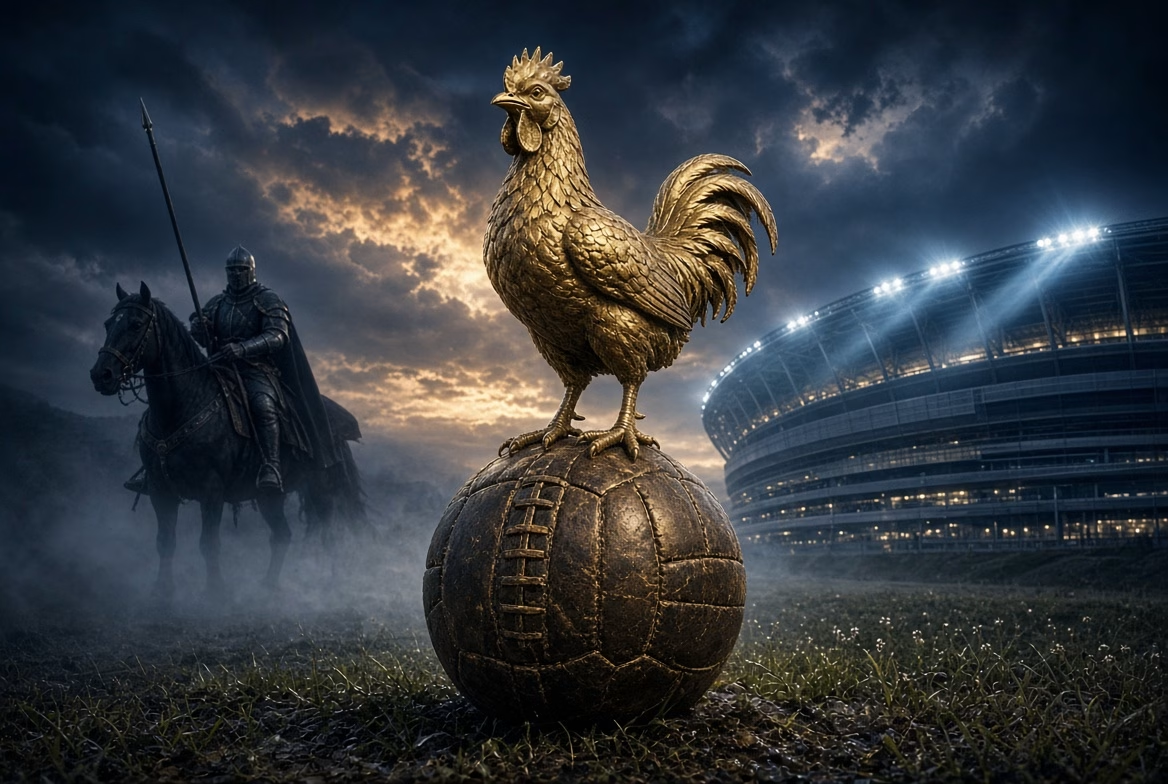
The cockerel has been part of the club’s visual identity since around 1900, and a bronze cockerel has stood on the roof of Tottenham’s ground for most of the time since — first at White Hart Lane, now at the Tottenham Hotspur Stadium, where the original bird, cast in 1909 and painstakingly restored, takes up its familiar position.
It is not there because the founders liked birds. A cockerel’s leg carries a spur — the sharp, bony protrusion just above the back claw, the thing that makes a fighting cock genuinely dangerous in the ring.
Put a cockerel on your badge and the spur is built right into the animal, a permanent visual pun on the word Hotspur that has been hiding in plain sight for over a century.
The spur on the cockerel’s leg and the spur in the club’s name are the same spur, connected across six hundred years.
Harry Percy earned his nickname from the speed of his cavalry charges. The schoolboys who named the club after him chose a cockerel as their emblem. The connection held, the badge endured, and most people who glance at it today are unaware of the story and history behind it.
Tottenham Hotspur were founded in 1882 as Hotspur FC by pupils from two north London schools — making them 144 years old in 2026.
Harry Hotspur — Henry Percy — died at the Battle of Shrewsbury on 21 July 1403, fighting against the forces of Henry IV. He was 39 years old.
The bronze cockerel now standing on the Tottenham Hotspur Stadium roof was originally cast in 1909 and stood on the old White Hart Lane for decades before being restored for the new ground.
Tottenham were the first club in the twentieth century to win the First Division and FA Cup double, achieving it in the 1960-61 season under Bill Nicholson.
The Tottenham Hotspur Stadium, opened in 2019, has a capacity of 62,850 — making it the largest club stadium in London.
The Lilywhites, and What “Come on You Spurs” Actually Means
Tottenham carry a second nickname — the Lilywhites — which refers to the white kit they have worn since the 1890s, reputedly inspired by Preston North End, who were the dominant force in English football at the time.
The Tottenham of that era decided they wanted some of whatever Preston had, and the white shirts stuck. Lilywhites is used mainly in formal writing and historical contexts; nobody at the Tottenham Hotspur Stadium is chanting about the Lilywhites on a match day.
In practice, of course, nobody chanting “Come on you Spurs” has Harry Percy anywhere near the front of their mind. The chant is just the chant — the noise north London makes on a match day, as automatic as breathing.
The fact that it traces back to a medieval battlefield is the kind of thing you either find fascinating or entirely beside the point, depending on what kind of football supporter you are.
But follow the chain back and it is still there. A medieval knight earned a nickname for the speed of his charges. A group of Victorian schoolboys chose that name for their football club because the knight had a local connection.
The club put a cockerel on their badge because cockerels have spurs. The supporters shortened Hotspur to Spurs because they were not going to chant six syllables when two would do.
The result is a club nickname that runs from a schoolboys’ meeting in 1882 back to a battlefield in 1403 — and forward again to one of the most expensive stadiums ever built in English football. Harry Hotspur would have found the stadium baffling, though he would have recognised the name.
Previously: Why West Ham are called the Hammers — two nicknames, one industrial origin, and a detail that surprises most people.
Next: Coming soon.

John Herman is a Leeds-based, would-be football writer and founder of Football Nonsense. Blending fan passion with sharp opinion, attempting to tackle the game’s biggest debates, from the terraces to the boardroom, with honesty, (attempted) humour, and heart.