Why Newcastle United Are Called
The Magpies.
The stripes came first. The bird followed. And the reason Newcastle ended up in black and white in the first place is one of English football’s genuinely unanswered questions — though the folklore around a certain counting rhyme fits the club’s history rather too well.
Newcastle United are called the Magpies because they play in black and white stripes. That’s the common-sense answer right? — a magpie is a black and white bird, the kit is black and white, the name followed naturally and has never been seriously questioned in over a century of use.
The more interesting question is why Newcastle play in black and white at all. And that, it turns out, is one of English football’s stubborn little mysteries — documented up to a point and then, frustratingly, not.
The Stripes Before the Name
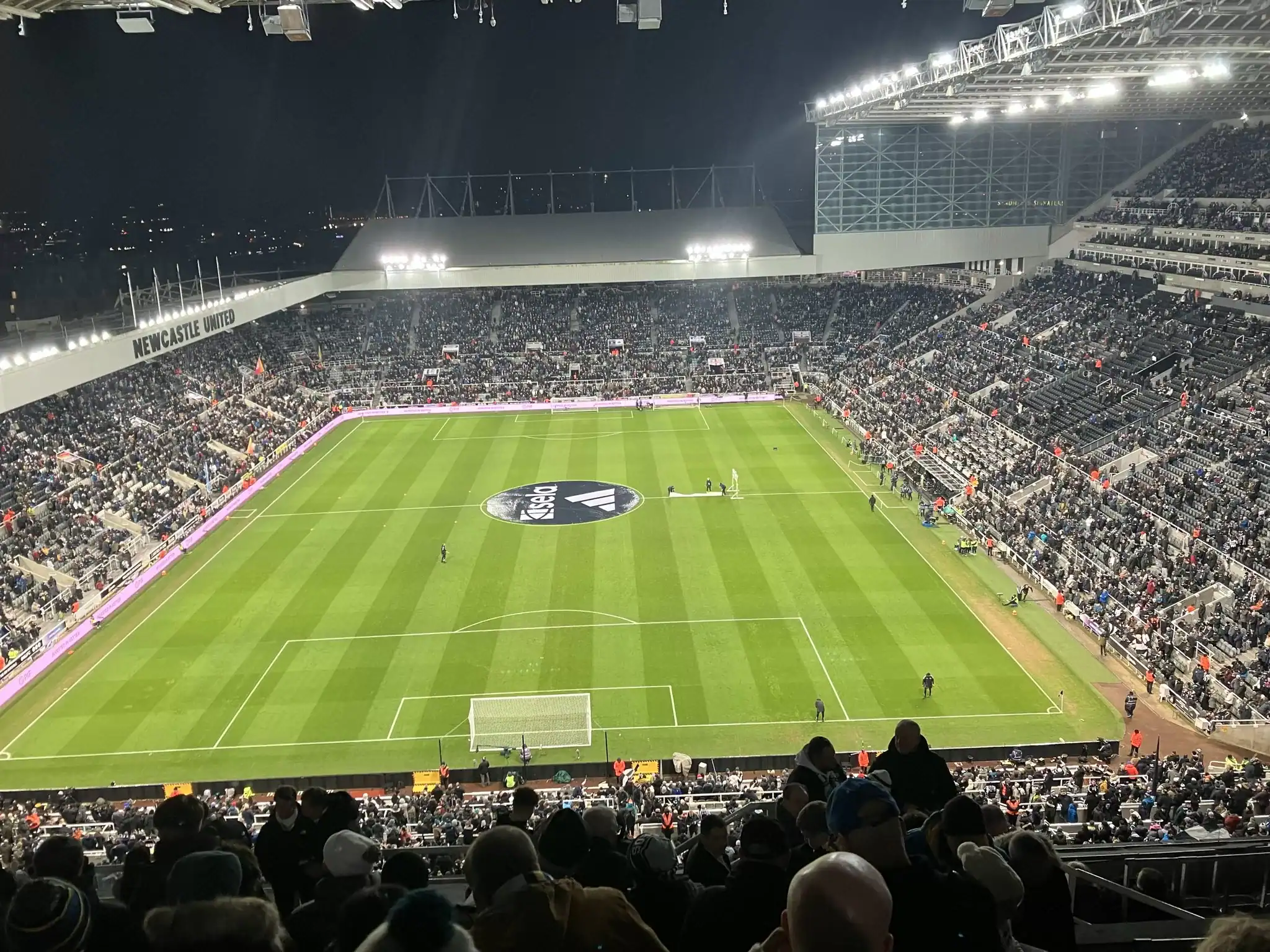
Newcastle United as a club was formed in 1892 from the merger of two local sides — Newcastle East End and Newcastle West End — both of whom had been competing for support in the city for the best part of a decade.
East End were the dominant force and effectively absorbed West End, inheriting their St James’ Park ground in the process.
What East End brought to the merger, among other things, was a kit. They had been playing in red and white stripes, which were changed to black and white some time in the early 1890s.
By 1894 the black and white stripes were established as Newcastle United’s colours, and they have remained so without serious interruption since.
Why the change was made, and why black and white specifically, is where the record gets thin. Three explanations have been offered over the years, and none of them is absolutely proven, but let’s look at them anyway.
The first traces the colours back to Newcastle’s civic heraldry. The city’s coat of arms features a black horizontal band — a heraldic “fesse” — on a silver background, which is as close to black and white as coats of arms tend to get.
The theory holds that the club adopted colours to reflect the city they represented, in the same way that several other Victorian-era clubs looked to local crests and symbols for their visual identity. It is plausible. It is also impossible to verify.
The second theory points towards Notts County, one of the founding clubs of the Football League and one of the most influential sides in Victorian football. Their black-and-white colours became widely recognised in the game’s early years, and a number of clubs are believed to have adopted similar kits as a result.
The most famous example is undoubtedly Juventus, who switched to black-and-white stripes in 1903 after receiving shirts modelled on those worn by Notts County, something still celebrated to this day
With Newcastle adopting black and white at the end of the nineteenth century, it’s easy to see why some historians have suggested a connection. Notts County’s influence on the developing game was considerable, and their distinctive colours had become synonymous with one of football’s most respected clubs.
However, while the theory is certainly plausible, there is no surviving evidence to show that Newcastle consciously chose black and white because of Notts County. Like many aspects of the club’s early history, the link remains an intriguing possibility rather than an established fact.
The third theory is perhaps the most mundane. Black and white were widely available, cheap to produce, and visually distinctive on a muddy pitch. Sometimes a kit colour is just a practical choice, and the deeper meaning comes later.
One for Sorrow: The Bird That Fits
Once you are playing in black and white, the choice of mascot is, arguably, fairly narrow. The Magpies nickname was in common use by the early 1900s and has never really faced a competitor — which is partly because “the Magpies” is a good nickname, clean and distinctive, but also because it reflects something about the club’s personality that supporters have always recognised.
The magpie is not, by the standards of English football mascots, a noble creature. The eagle soars. The lion commands. The magpie chatters, hops, nicks things it shouldn’t, and is associated in English folklore with superstition and uncertain fortune — specifically the counting rhyme that most people, over a certain age in this country, can recite from childhood: one for sorrow, two for joy, three for a girl, four for a boy. etc. (Something perhaps younger readers may not get)
One for sorrow, two for joy,
Traditional English counting rhyme — origins disputed, in common use since at least the eighteenth century
three for a girl, four for a boy,
five for silver, six for gold,
seven for a secret never to be told.
For anyone following Newcastle United over the past half-century, “one for sorrow” has periodically felt like the club’s official motto.
For generations of Newcastle supporters, supporting the club required an almost irrational faith that better days lay just around the corner.
There were exhilarating near-misses, none more memorable than Kevin Keegan’s entertainers of the mid-1990s, whose title challenge captured the imagination of English football before slipping agonisingly away.
But where previous eras had ultimately left only memories, the League Cup victory in 2025 finally brought a long-awaited reward, ending a seventy-year wait for a major domestic trophy.
The takeover of 2021 changed the trajectory of the club, but it was that Wembley afternoon four years later that altered the mood on Tyneside. The sense of possibility is no longer based solely on ambition or potential.
Yet the magpie, with all its folklore of fortune and fate, still feels an appropriate emblem for a club whose history has been built as much on belief as achievement.
St James’ Park: The Ground in the Middle of Everything
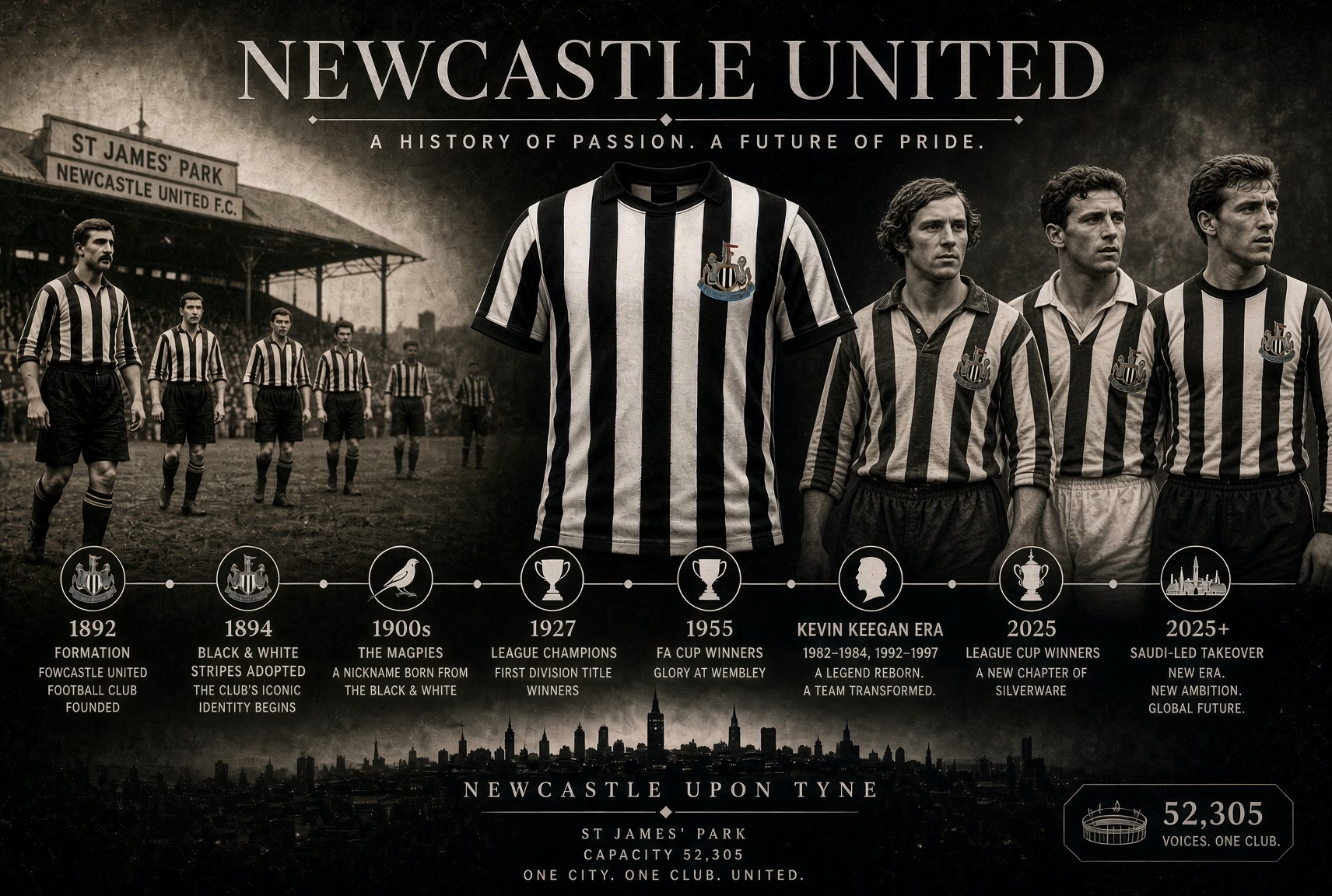
Part of what makes the Magpies identity stick is where the club plays. St James’ Park is unusual among English football grounds in that it sits not on the outskirts of the city — not beside a retail park or tucked into an industrial estate — but right in the heart of Newcastle upon Tyne itself.
A 52,000-seat stadium within comfortable walking distance of the city centre, rising above the terraced streets in a way that makes it visible from most of the surrounding area and impossible to ignore from almost anywhere in town.
This matters because Newcastle is one of those clubs where the ground and the city have never been separable. The Tyne is part of it. The Geordie accent and the Geordie identity are part of it. The sense that supporting Newcastle United is less a lifestyle choice than a civic fact — something you are born into, like the river and the bridges and the grey sky — is baked into the culture in a way that the word “fan” doesn’t quite cover.
“Howay the lads” is the chant, as it has been for generations. It is not a song about football. It is a declaration about where you are from and who you are with, and it happens to take place in a stadium.
Newcastle United were formed in 1892 from the merger of Newcastle East End and Newcastle West End. East End were the dominant force, inheriting St James’ Park — which had belonged to West End — in the process.
The black and white stripes were established by 1894. The exact reason for the choice is undocumented, with theories pointing to civic heraldry, the influence of Notts County, or simple practicality.
The Magpies nickname was in widespread use by the early 1900s — a natural consequence of the kit colours.
Newcastle last won the Football League title in 1927, and the FA Cup in 1955. The mid-1990s Keegan side came closest since, finishing runners-up in 1995-96 and 1996-97 after leading the league by 12 points in January. Their most recent triumph was in winning the League Cup in 2025
St James’ Park holds 52,305 and sits in Newcastle city centre — one of the few top-flight grounds genuinely embedded within its city rather than on its edge.
The club was taken over by a Saudi-led consortium in October 2021, ending 14 years of ownership under Mike Ashley and beginning a significant investment era.
Just the Stripes, the Noise, and the Tyne
Nobody walking up to St James’ Park on a matchday is thinking about heraldic fesses or the history of the famous blank and white stripes. The Magpies is just what Newcastle are — the name that has been used for over a hundred years, embedded so deeply into how the club is talked about that it has stopped needing a reason.
Whether the black and white came from the city coat of arms, or a football club in the East Midlands, or someone in the 1890s who just thought it looked good — that is the kind of thing that gets interesting on a slow afternoon with a good search engine. At a quarter to three on a Saturday, it is just the stripes, the noise, and the river.
Previously: Why Arsenal are called the Gunners — a munitions factory, a cannon that changed direction, and the most controversial vote in Football League history.
Next: Coming soon.

John Herman is a Leeds-based, would-be football writer and founder of Football Nonsense. Blending fan passion with sharp opinion, attempting to tackle the game’s biggest debates, from the terraces to the boardroom, with honesty, (attempted) humour, and heart.